Run a Solar-Access (Sun) Study with AI

Short answer: You can run a solar-access (sun) study straight from your AI client by asking Archi Automate to call sim_sun. It computes the hours of direct sunlight per element for a chosen date and daily time window using standard astronomy and a shadow raycast against your model's own geometry. It is fully offline, vendor-neutral, and fast — an early-design study, not a certified solar or energy simulation.
Daylight and sun exposure shape almost every consequential design decision: where the living spaces go, how a courtyard performs, whether a neighbour will object, and how much glare a workspace inherits. The problem is that most teams only get this insight late, after a specialist runs a formal analysis package. By then the massing is frozen and changes are expensive. An AI-driven solar-access study lets you ask the question on day one — in plain language, against the model you already have — and iterate before anything is committed.
Why early sun and solar-access insight matters
A solar-access study answers a deceptively simple question: how many hours of direct sun does each surface, room, balcony, or facade panel receive on a given day? That single number drives daylighting strategy, overheating risk, PV placement, planting, amenity quality, and right-to-light conversations with neighbours. Getting an approximate answer in seconds, mid-conversation, changes how you design. You stop guessing about orientation and start testing it.
Because Archi Automate connects your AI client to the model through MCP, you do not export anything or switch tools. You ask, and the assistant composes governed operations at runtime to read the geometry, run the study, and report back. Read only is the default, so nothing in your model changes when you run an analysis like this.
Run sim_sun for a date and a daily window
The core of the workflow is one operation. You tell the assistant the date you care about and the daily time window — say the 21st of June from 08:00 to 18:00 — and ask it to run a sun study. Under the hood, sim_sun computes the sun's position throughout that window using standard astronomy, then casts shadow rays against the model's own geometry to determine, element by element, how many hours of direct sun each one receives.
You can phrase it naturally: “Run a solar-access study for the 21st of December, 09:00 to 16:00, and tell me which rooms get less than two hours of direct sun.” The result comes back as hours of sunlight per element. If you provide an output directory, sim_sun writes a results.json plus a still image you can drop into a report; without one, it returns the results inline so you can keep iterating in the conversation.
This per-element granularity is what makes the study useful beyond a pretty shadow picture. You can compare two massing options, flag the units that fail a minimum-sunlight target, or rank facade panels by exposure for a shading strategy — all from text prompts, all without leaving your AI client.
Georeference: IfcSite or an explicit lat/lon
A sun study is only as good as its location and orientation. sim_sun takes its georeference from the model's IfcSite when one is present, picking up latitude, longitude, and orientation directly. If your model is not georeferenced — or you want to test the same building on a different site — you can pass an explicit latitude and longitude override in the prompt. Just say “use lat 51.5, lon -0.12” and the study recomputes sun positions for that location.
This matters because the difference between a London winter and a Madrid winter is enormous in solar terms. Being explicit about georeferencing turns a generic shadow study into a site-specific one you can defend.
Overlay in the viewer, scrub the hours, capture an image
Numbers are persuasive; pictures are memorable. After the study runs you can overlay the results in the local 3D viewer and walk a reviewer through the day. Ask the assistant to step through the hours: it uses viewer_set to scrub the hour-of-day so you can watch shadows sweep across the model. When you reach the moment that makes your point — the worst-case overshadowing at 15:00, say — viewer_capture grabs a clean presentation image.
The whole sequence stays inside the AI conversation. You run the study, overlay it, scrub to the critical hour, and capture a figure for the deck, without opening a separate analysis application or rendering pipeline.
Include neighbour shadows via site context
Your own building rarely overshadows itself in the ways planners care about — the neighbours do. Before running the study you can ask the assistant to pull in surrounding buildings as site context from open data. With those neighbouring volumes loaded into the model, the shadow raycast in sim_sun includes their shadows too, so the hours-of-sun figures reflect the real urban condition rather than an isolated object on an empty plot.
This is the difference between a study that survives a planning meeting and one that gets dismissed. Pulling context first costs you one extra prompt and makes the result far more honest about overshadowing.
Be honest: this is an offline study, not a certified simulation
It is worth being precise about what sim_sun is and is not. It is a fast, offline solar-access study built from two well-understood ingredients: standard astronomy for the sun's position, and a geometry shadow raycast against the model. There is no solver and no network call. That makes it ideal for rapid, early-stage iteration where you want directional answers in seconds.
It is not a certified or validated solar, energy, or radiation simulation. It does not model diffuse sky radiation, reflections, atmospheric conditions, or compliance metrics, and it should never be presented as a substitute for accredited daylight, right-to-light, or energy analysis. Use it to make better decisions early and to narrow your options; hand off to specialist, validated tools when you need certified numbers for approval or sign-off.
Vendor-neutral, local, and offline by design
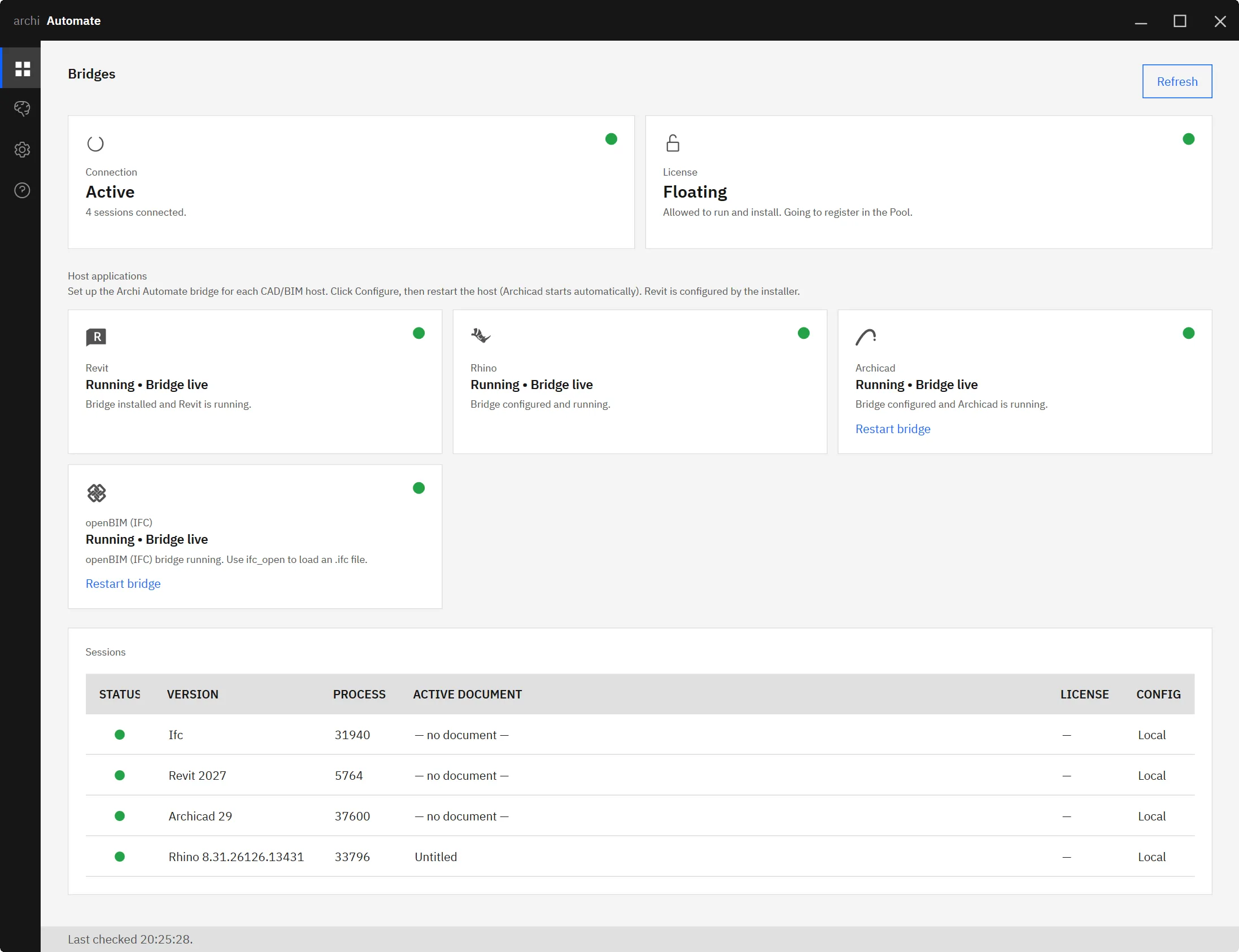
Because the study runs against IFC geometry, it does not care which tool authored the model. Archi Automate (AI for AEC) connects AI clients to Revit 2025–2027 (Autodesk), Rhino 8 (McNeel), and Archicad 29 (Graphisoft), plus an openBIM path covering IFC, IDS, and BCF. The openBIM connector is headless — no CAD application or licence is required — so a sun study runs on IFC exported from any tool, on a single Windows machine, with the computation staying local. Everything installs from one Windows installer, with a 14-day trial and no key.
Guardrails apply throughout. Read only is the default, Preview lets you see what an operation would do, and Allow changes is an explicit opt-in. Actions are audited and nothing is auto-saved, so an analysis pass never quietly alters your model.
Where to go next
If you want to understand the openBIM plumbing behind a headless study, start with MCP for IFC and openBIM and connecting Claude to your AEC tools. To pull neighbouring buildings before a sun study, see adding site context from open data. For more on the viewer used to overlay and capture results, read about the AI BIM 3D viewer. And once you are thinking about sustainability metrics more broadly, embodied carbon from IFC with AI is a natural companion.
Ready to run your first solar-access study from your AI client? Get started with Archi Automate — AI for AEC.